
 Francais
 English
 Deutsch
 Italiano
 Espanol
 Nederlands
 Polski
 Portugues
 Romana
 Ellenika
 Magyar
 Svenska
 Bulgarski
 Dansk
Dansk
 Suomi
Suomi
 Slovencina
 Hrvatski
 Lietuviu
 Slovenscina
 Latviesu
 Eesti
Eesti
Cannabutter is the foundation of the entire cannabis kitchen. Before the space cake, before the cookies, before the brownies, there is always the same green butter, concentrating the plant's active compounds into a fat that blends into anything you cook, sweet or savoury.
The good news: you need neither lab equipment nor any particular talent. A saucepan, butter, a bit of patience, and above all two or three rules you cannot afford to get wrong. That is exactly where the difference is decided between a butter that does nothing at all and one that is far too strong and takes the evening somewhere you did not plan to go… 😜
In this guide: the cannabutter recipe step by step, the quick version for when you are short on time, how much weed to use and how to dose per serving, what works with dry trim, flower or hash, and how to store it for months without losing potency.
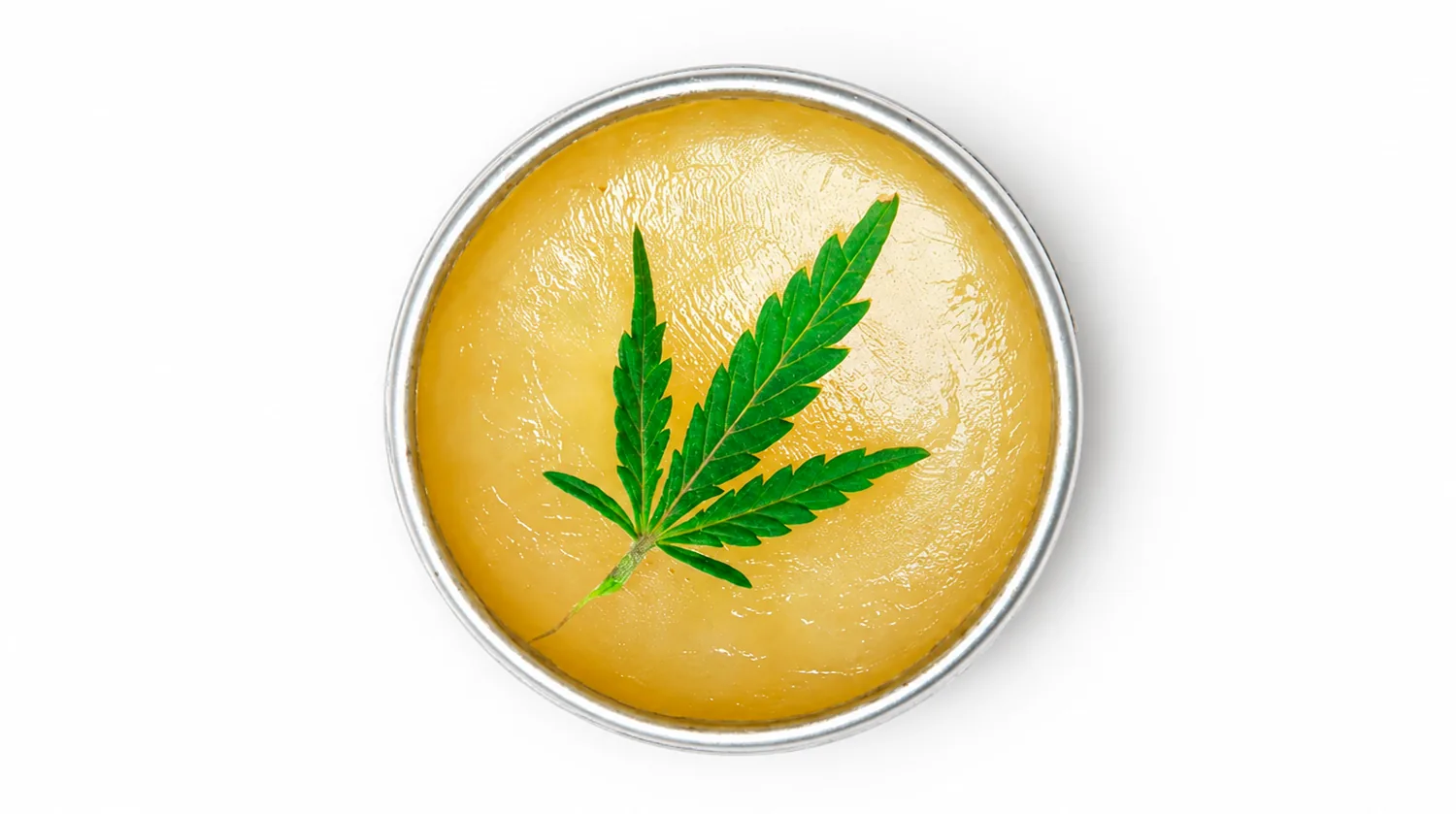
What is cannabutter?
Cannabutter is simply butter infused with cannabis. Plant material (flower, trim or hash) is gently heated in melted butter: cannabinoids are fat-soluble, so they migrate out of the plant and into the fat. The butter turns green, aromatic and, above all, psychoactive.
From there it serves as the base for any recipe containing butter: cakes, cookies, pasta, toast. It is an ingredient, not a dish.
Cannabutter, weed butter or hash butter?
There is no difference in substance, only in usage:
- Cannabutter and weed butter mean exactly the same thing. Both are common; "cannabutter" is the more searched term.
- Hash butter usually refers to a preparation made from hash rather than flower. The method is identical, only the dosage changes (see below).
In French the same preparation is called beurre de Marrakech, a name inherited from the 1960s when travellers brought hash back from the Moroccan Rif. Same product, different name.
Ingredients and equipment
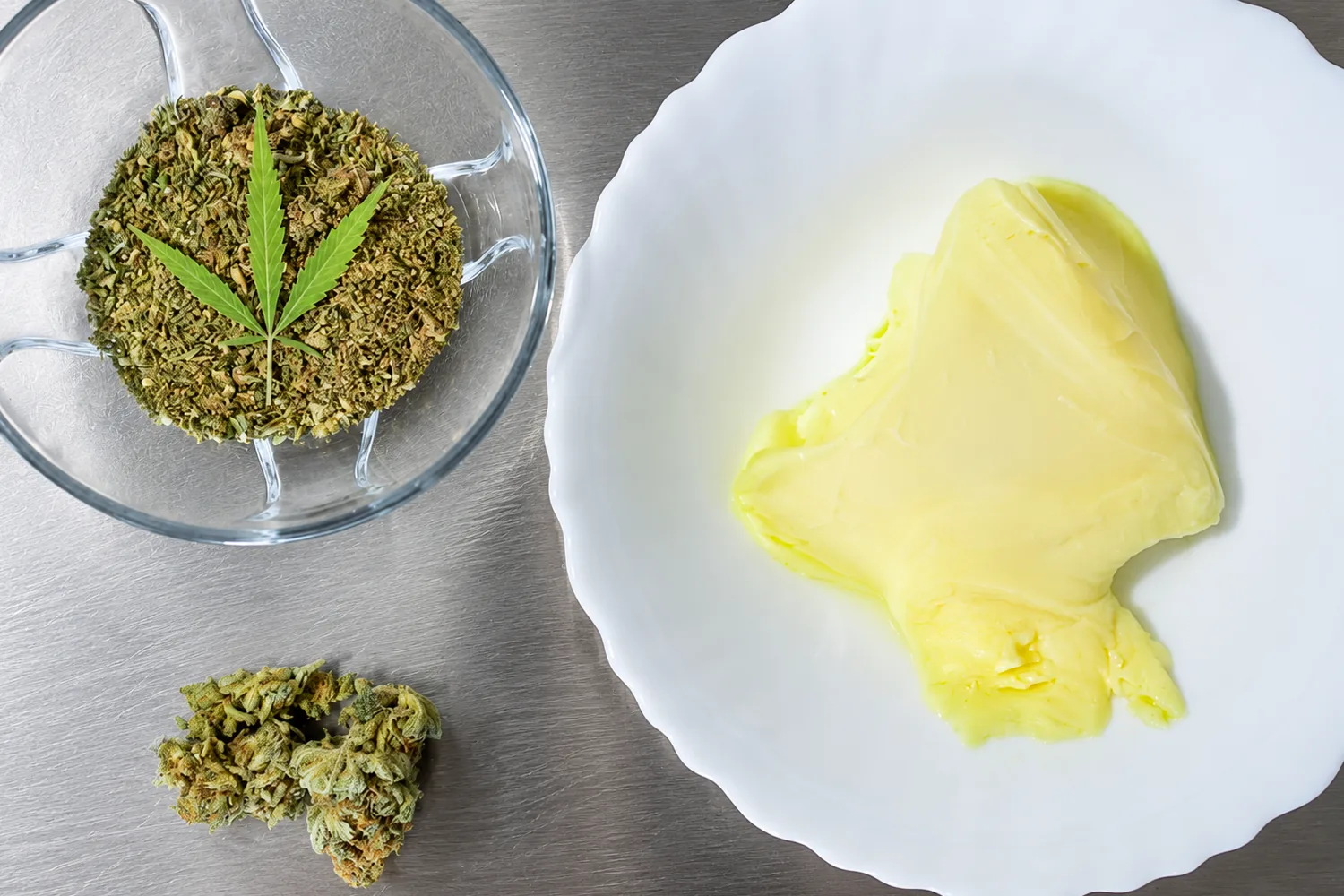
For roughly 250 g (about 2 sticks) of cannabutter:
- 250 g unsalted butter: classic butter remains the best carrier (oils work too, more on that below). Butter at 82 % fat gives a better yield than a low-fat spread.
- 10 to 15 g of dried flower (or 5 to 8 g of hash): see the dosage section below.
- 250 ml of filtered water: it stops the butter from scorching and captures part of the bitterness. It gets removed at the end, so don't worry about it.
For equipment: a heavy-bottomed saucepan, a fine sieve, a piece of cheesecloth (or two, or a coffee filter, or any clean tight-weave cloth), an airtight container, and a kitchen thermometer if you have one.
💡 Coconut oil and MCT oil work just as well and keep even longer (spoiler: that is exactly what our own Cannabutter is based on, and it tastes nothing like coconut). They are richer in saturated fats, which slightly improves extraction. They are also the vegan option by default.
Oil has one advantage butter does not: it stays liquid, so it can be dosed drop by drop and stirred cold into a dressing, a smoothie or a plated dish, with no cooking at all. If you would rather skip the preparation entirely, our 100mg THC & CBD oil is ready to use and already titrated.
Dry or fresh trim, flower, hash: what can you use?
This question comes up constantly, and the answer changes the result a great deal.
Dry or fresh leaves?
They must be dry, always. Fresh leaves hold a lot of water and chlorophyll: the butter comes out very green, very grassy, and above all far weaker, because the cannabinoids are still mostly in their acidic, non-psychoactive form.
If fresh material is all you have, air-dry it away from light for 5 to 10 days before using it.
Flower, trim or stems?
- Flower (buds): the most concentrated, the best yield. It is the reference for every dosage below.
- Sugar leaves (the small leaves close to the buds): usable, but count roughly three times the amount for an equivalent effect.
- Fan leaves and stems: very few cannabinoids. You can use them to waste nothing, but the effect will be weak and the taste very vegetal. Honestly, keep that as a last resort — your baking deserves better 😎.
What about hash?
Hash is naturally more concentrated than flower. Count about half the amount: 5 to 8 g of hash per 250 g of butter. Crumble it finely and decarboxylate it too, slightly shorter: 20 to 25 minutes is enough.
The step you cannot skip: decarboxylation
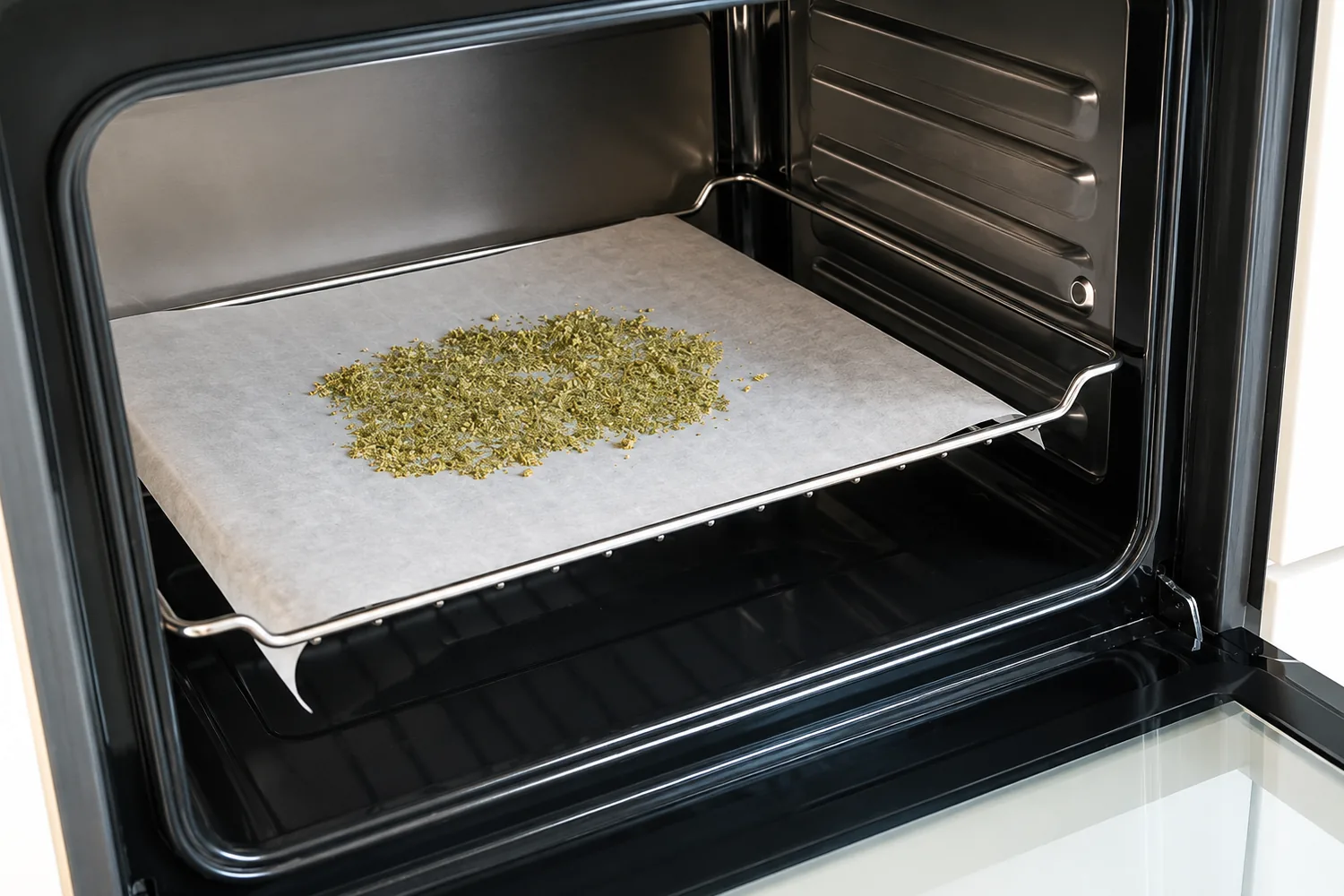
This is the step half the recipes rush through, and the number one cause of failed cannabutter.
In the raw plant, THC barely exists: it is present as THCA, an acidic molecule with no psychoactive effect. Converting it requires heat. That is decarboxylation.
How to do it:
- Preheat the oven to 110 °C / 230 °F (fan-assisted if possible).
- Break the flower up coarsely: do not grind it to powder, or it will slip straight through your filter later.
- Spread it on a baking tray lined with parchment paper.
- Bake for 30 to 40 minutes, stirring once halfway through.
- The material should turn golden brown and brittle, but not black: keep an eye on it and don't burn the lot.
⚠️ Do not go above 120 °C / 250 °F: beyond that THC starts to degrade and terpenes evaporate. You lose potency and flavour.
Cannabutter recipe, step by step
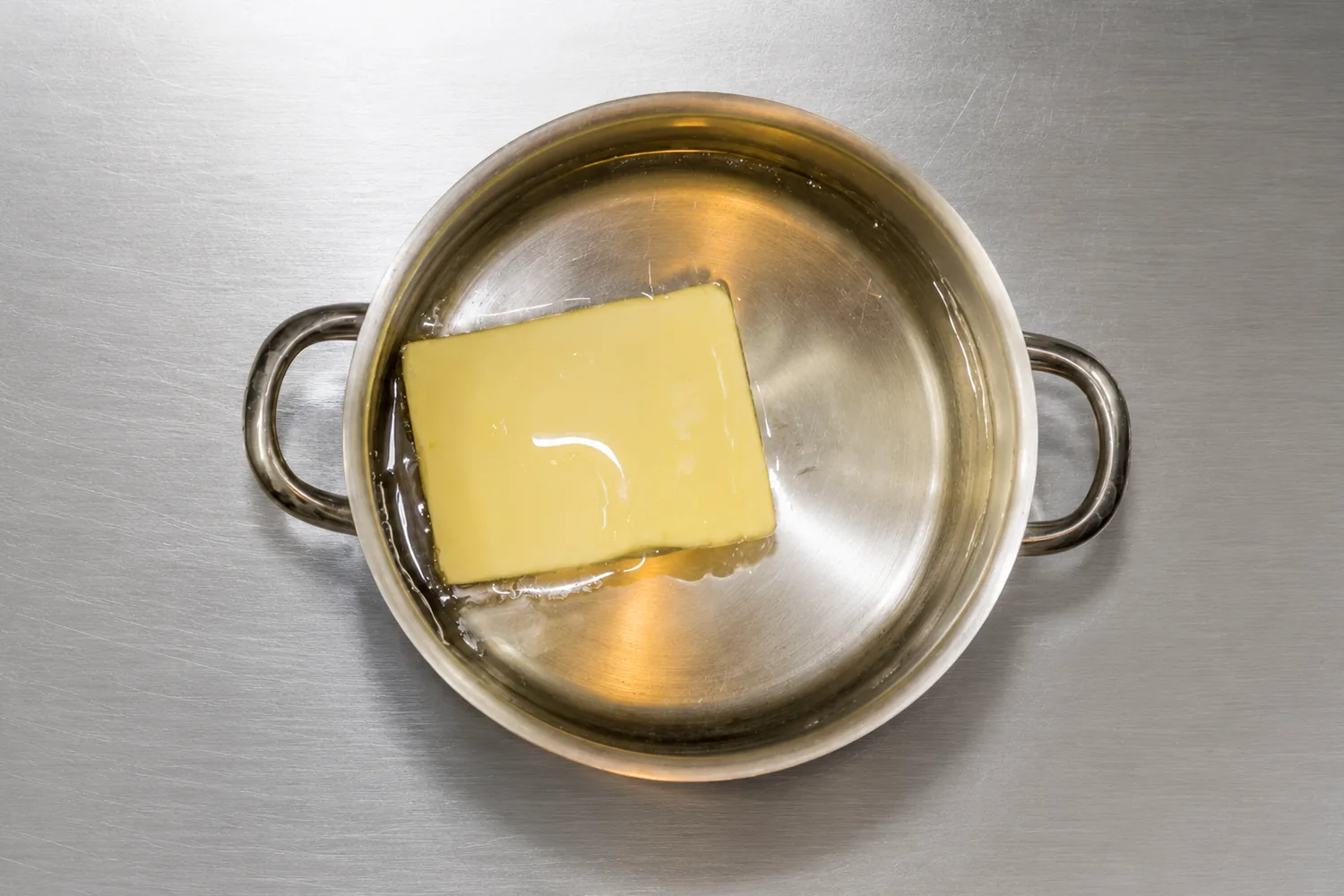
- Melt. In a heavy-bottomed saucepan, pour 250 ml of water and 250 g of butter cut into pieces. Heat gently until fully melted.
- Add the material. Stir in the decarboxylated flower until it is fully submerged.
- Infuse slowly. Hold between 85 and 95 °C (185–205 °F) for 2 to 3 hours. The mix should barely shiver, never boil. Stir every 20 to 30 minutes.
- Strain. Pour through cheesecloth (double it if you can) set over a sieve above a container. Do not squeeze hard: you would push chlorophyll through and turn the taste bitter. By this point the cannabinoids are already in the fat anyway. Just let it drip.
- Chill. Refrigerate for 3 to 4 hours. The butter sets on top, water and impurities stay underneath.
- Separate. Lift off the solid disc of butter, discard the greenish water, pat the underside dry. Done 😋.
Total time is around 4 hours, of which only about 20 minutes is actual work. The rest is waiting.
Quick cannabutter recipe
No 4 hours to spare? There are shortcuts. They are less efficient (expect 10 to 30 % lower yield), but they will do in a pinch.
30-minute version (double boiler)
After decarboxylation, melt the butter in a double boiler, add the material and hold at 90 °C for 30 minutes, stirring. Strain as usual. It is the best speed-to-quality compromise.
Cannabutter without water
Water is not compulsory: it acts as a heat buffer and cuts bitterness. Without it the infusion is shorter (1 to 2 hours) and the butter tastes more concentrated, but the risk of scorching is far higher. Only worth it if you control your heat well, and with a thermometer.
Cannabutter without an oven
With no oven, decarboxylation can be done in a pan: crumbled material over very low heat, 20 minutes, stirring constantly. It is less even than an oven, so watch it closely. Alternative: extend the infusion to 3 or 4 hours to compensate in part.
Cannabutter in an air fryer
Air fryers decarboxylate very well: 110 °C for 20 to 25 minutes, with the material in a suitable container or wrapped in foil so the fan does not blow it everywhere. Careful though, air fryers often run hotter than the displayed temperature — drop it by 10 °C on your first attempt.
Dosage: how much per person?
This is the most important section on this page. Badly dosed butter means either a disappointment or a genuinely unpleasant evening. Both are avoidable.
The maths
Take 10 g of flower at 15 % THC, for 250 g of butter:
- 10 g × 15 % = 1,500 mg of theoretical THC
- After decarboxylation and extraction you recover 60 to 70 % at best, so 1,000 mg maximum
- Spread across 250 g of butter, that gives 4 mg of THC per gram of butter
If your cake uses 100 g of that butter and is cut into 10 slices, each slice holds roughly 40 mg of THC. Forty milligrams eaten by a first-timer is a guaranteed bad trip, and probably the end of any desire to try again. Start low and test your tolerance instead, and the experience is a completely different one.
Reference points per person
- Beginner: 2 to 5 mg of THC
- Occasional use: 5 to 10 mg
- Regular consumer: 10 to 25 mg
- Above 30 mg: high risk of unpleasant effects for most people
In other words, with the butter calculated above, a 40 mg slice is four to eight times too strong for a beginner. Hence the point of diluting: mix your cannabutter with plain butter to adjust the strength.
What about CBD?
The method is exactly the same with CBD flower. Cannabidiol dissolves into fat on the same principle as THC, with identical decarboxylation (CBDA converts to CBD in the same temperature range).
The resulting CBD cannabutter is non-psychoactive: no high, but a relaxing effect that some people appreciate in the evening. It is the version that lets you cook daily without affecting alertness.
Two practical differences:
- Dosage is far more forgiving. CBD has no overdose effect comparable to THC: a high concentration causes drowsiness at worst.
- CBD flower usually states its content clearly (a percentage), which makes the maths easier than with hash of unknown strength. But be careful where you buy: for months now, CBD flower sprayed with synthetic cannabinoids has been showing up. Those are lab chemicals, and they have no business in your baking.
To extract as much cannabidiol as possible, extend the infusion (3 hours) rather than raising the temperature: CBD migrates into fat a little more slowly.
The video below walks through making cannabutter and what to do with it, a useful complement to the recipe above.
What effects to expect, and how fast?
Eaten, cannabis behaves very differently from inhaled cannabis. That is the number one source of bad experiences.
- Onset: 30 minutes to 2 hours. Far slower than smoking.
- Peak: 2 to 4 hours after eating.
- Total duration: 4 to 8 hours, sometimes up to 12 at a high dose. So maybe not at 8 a.m. before work 😅.
- Intensity: the liver converts THC into 11-hydroxy-THC, a stronger metabolite. At an equal dose, the effect is stronger than smoking.
⚠️ The absolute rule: wait 2 hours before having more! The vast majority of bad experiences come from someone feeling nothing after 45 minutes, taking another slice, and then getting both doses at once.
🚩 It is genuinely unpleasant in the moment, and it can feel long, but it does pass. By the next day at the latest, everything is back to normal.
In case of an overdose there is no danger to life, but it is a very uncomfortable stretch (anxiety, nausea, racing heart, disorientation). Stay calm, drink water, eat something sweet (no more space cake), and wait it out.
Storing cannabutter
- Fridge: 3 to 4 weeks in an airtight container.
- Freezer: up to 6 months. Ideally in portions (an ice cube tray) so you only thaw what you need.
- Away from light: UV degrades cannabinoids. Opaque container or dark cupboard.
💡 Always label the jar! With the date and the estimated strength. Cannabutter looks like ordinary butter and must be identifiable, kept out of reach of children and pets. If someone drops by on a Sunday and helps themselves to toast, the afternoon will not go as planned.
Why is my butter separating?
If a liquid layer forms, it is usually residual water that was not properly removed while chilling. Chill it again and carefully lift off the watery phase. It is not a quality problem, just incomplete straining.
Price: make it or buy it?
The cost of homemade cannabutter depends almost entirely on the raw material. For 250 g of butter with 10 g of flower, expect somewhere between £25 and £90 depending on quality (THC, CBD). The butter itself accounts for £2 to £3.
Ready-made preparations exist as cannabis butter, already dosed and calibrated. It costs more per gram, but you gain consistent dosing and save the 4 hours of preparation.
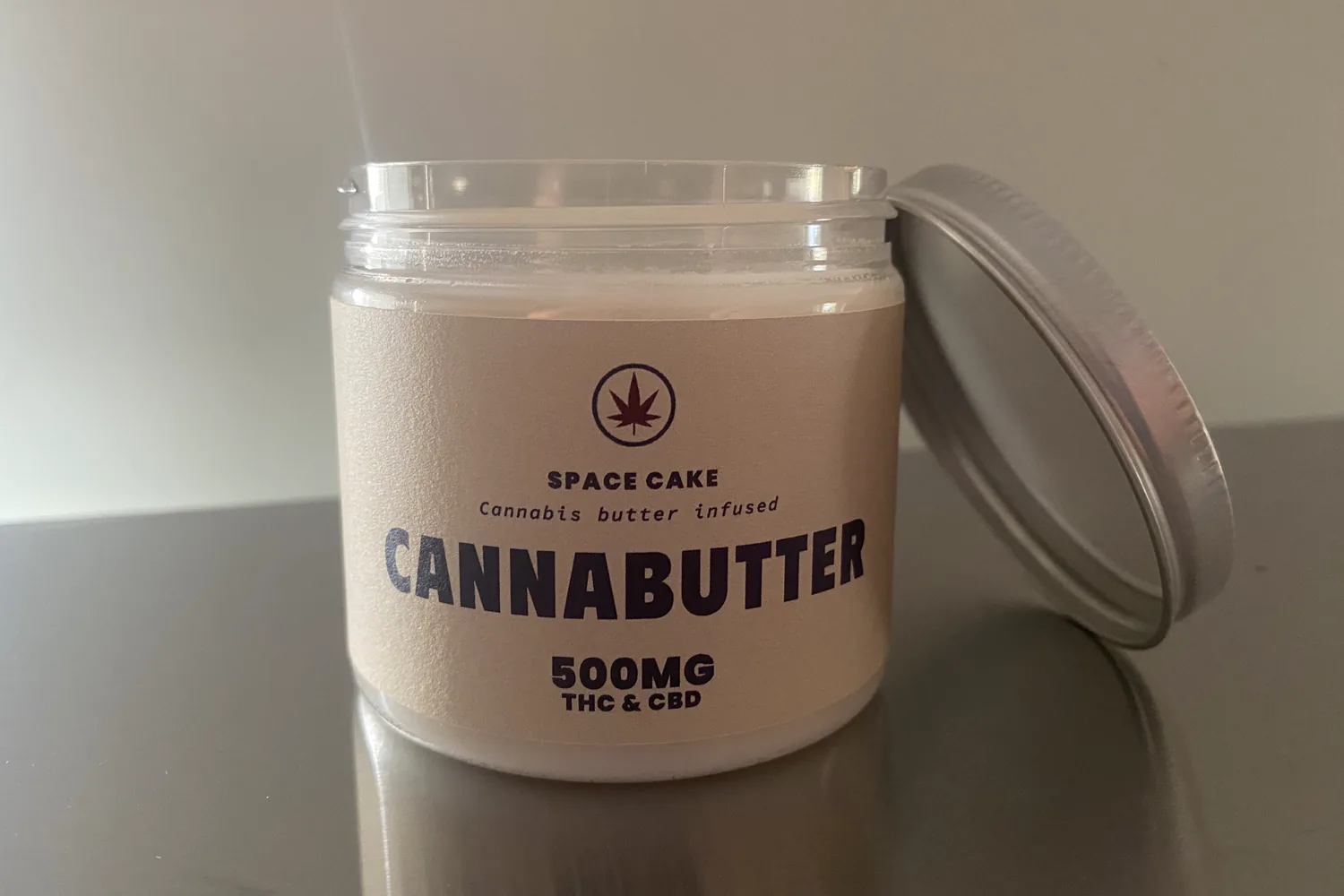
👉 Have a look at our Cannabutter, dosed at 500 mg THC and 500 mg CBD (organic coconut oil base, neutral in taste and odourless).
What can you make with cannabutter?
It replaces ordinary butter in any recipe, as long as you do not overheat it (avoid frying and anything above 180 °C / 355 °F, which degrades the cannabinoids you just extracted).
Baking
- The homemade space cake, the historic use.
- Cannabis cookies, easier to dose one by one.
- The classic cannabis cake.
- Pancakes, madeleines and shortbread, where butter is already the central ingredient.
Savoury dishes
Often forgotten, but it works just as well as the sweet side:
- Melted over fresh pasta with parmesan: the warm fat spreads beautifully.
- Into a risotto, stirred in off the heat at the end, in place of the finishing butter.
- In mashed potato or over steamed vegetables.
- Whisked into cream for a sauce, adding the butter once the heat is off.
And the simplest of all: cold, on toast. It is the most reliable way to control your dose, since you weigh exactly what you spread.
Frequently asked questions
Does it smell strong while you make it?
Yes, quite noticeably. Oven decarboxylation and especially the 2 to 3 hours of infusion fill the whole home, and the smell clings to fabric. What helps: extractor fan on full, a window ajar, kitchen door shut, decarboxylation sealed in foil, and infusion with the lid on. It won't remove the smell, but it cuts it down a lot.
Can you reuse the strained material for a second extraction?
Yes, but the yield is low: roughly 10 to 20 % of the cannabinoids remain in the spent material. You can re-infuse it in a small amount of butter for a light version. Beyond a second pass it is not worth it.
Can you make it in a Thermomix or a butter machine?
Yes, and it is more comfortable. Cooking robots hold temperature far better than a saucepan: set 90 °C, 2 hours, slow stir. Dedicated machines such as the Magical Butter run the full cycle, filter included. The principle does not change: decarboxylate first, never boil afterwards.
Why isn't my cannabutter green?
Colour depends on the material used, not on potency. Butter made from hash leans brown-gold, butter made from flower leans deep green. A very dark, almost brown butter points to overheating instead. The key thing: colour is not an indicator of dosage.
Does cannabutter lose potency over time?
Yes, slowly. THC degrades into CBN under light, air and heat, which gradually makes the effect more sedative. In the freezer, in an opaque airtight container, the loss stays minimal over six months.
How much weed do you need for cannabutter?
As a rule of thumb, 10 to 15 g of dried flower per 250 g of butter, or 5 to 8 g of hash. For a milder everyday butter, drop to 5 g of flower. What matters is not the quantity alone but the THC content of the material — so always run the maths (see the dosage section).
How long is cannabutter detectable after eating it?
Far longer than the effects last: several days for occasional use, up to several weeks for regular use. Edibles are often detectable longer than smoked cannabis, because metabolism is slower.
Can you use salted butter?
No technical problem: extraction is identical. It is purely a matter of taste. Salted butter pairs well with caramel, cookies or shortbread, a little less with a delicate cake.
Want to enjoy the Space Cake experience at home?
Our cones and cookies are made with full spectrum cannabis, lab-tested, and delivered straight to your door. 100% legal in Europe.
🛒 DISCOVER THE SHOP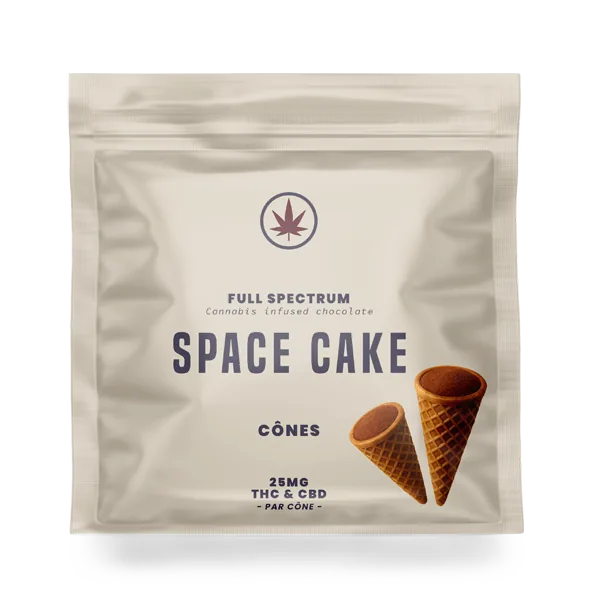


Comments
Be the first to comment on this article!
Leave a comment